Oring
VIGHNESH Rubbers with extensive industry expertise into the manufacturing of o ring products. Quality is the lifeline of Vighnesh rubbers and the symbol of our corporate reputation. With comprehensive quality inspection system, we are able to assure that every o ring is standard-specific and reliable. Professionalism and efficiency are pivotal to Best Ring's field leading position. If you wish to learn more o ring products, please use online form or e-mail to contact us. Our customer representatives will revert back to you ASAP.
O Ring ApplicationsThis section provides an overview of the most common types of the O-Ring sealing applications. All O-Ring sealing applications can be classified as either static or dynamic.
- Static axial seals: In this application the compression is on the top and bottom of the O-Ring, which is similar to a flat gasket. Static axial seals are typically utilized in face seal applications, as show: 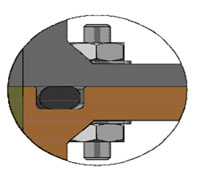 Fig.: Typical static axial seal - Static radial seals: This application means that the compression is between the inside diameter and the outside diameter of the O-Ring. Typical static radial seals are cap seals and plug seals.
- Reciprocating Seals: In a reciprocating seal, there is relative reciprocating motion (along the shaft axis) between the inner and outer elements. This motion tends to slide or roll O-ring, or sealing surface at the O-ring, back and forth with the reciprocal motion. O-Rings used in reciprocating applications are called piston or rod seals.
- Oscillating Seals: In an oscillating seal, the inner and outer components of the groove move in an arc around the axis of the shaft, first in one direction and then in the opposite direction, usually intermittently, with no more than a few turns in each direction. The most common application for oscillating O-Ring seals is in valves. - Rotary Seals: In a rotary seal, either the inner or outer member of the sealing elements turns (around the shaft axis) in one direction only. This applies where rotation is reversible but does not allow for starting and stopping after brief arcs of motion which is classed as an oscillating seal. Examples of a rotary seal include sealing a motor or engine shaft, or a wheel on a fixed axle. Other types of O rings used - Seat Seals: In a seat seal, the O-ring serves to close a flow passage as one of the contact members. The motion of closing the passage distorts the O-ring mechanically to create the seal, in contrast to conditions of sealing in previously defined types. A sub-classification is closure with impact as compared with non-impact closure. Examples of a seat-seal include and O-ring as a “washer” on the face of a spiral threaded valve, a seal on the cone of a floating check valve, and a seal on the end of a solenoid plunger. - Pneumatic Seals: A pneumatic seal may be any of the previously described types of O-ring seals but is given a different classification because of the use of a gas or vapour rather than a liquid. This has a vital affect on the lubrication of the O-ring and thus influences all moving (or dynamic) seal installations. A further point is that pneumatic seals may be affected by the increase in gas temperature with compression. Note that the seal should be defined as “pneumatic-rotary” etc. for complete identification. - Vacuum Sealing: A vacuum seal confines or contains a vacuum environment or chamber. The vacuum seal may be any of the previously defined types (except a pneumatic seal) and as in the case of “pneumatic seals”, both terms applicable to the seal should be given for complete identification. This classification is given primarily because, in most cases, the leakage tolerance is less than for pressure seals. In addition, the problem of pressure trapped between multiple O-rings, which increase the load on a single O-ring, does not apply. Multiple O-rings are useful in a vacuum seal. - Cushion Installation: Such an application requires that the O-ring absorb the force of impact or shock by deformation of the ring. Thus, forcible, sudden contact between moving metal parts is prevented. It is essentially a mechanical device. An example is the use of an O-ring to prevent metal-to-metal bottoming of a piston in a cylinder. The O-ring must be properly held in place as otherwise it might shift and interfere with proper operation of the mechanism. Quick guide for O-Ring selectionSelect the elastomer: The most important characteristics of the material to be selected are Temperature resistance and Chemical resistance.
Select the hardness: The hardness of 70 Shore A is most common and it gives a good sealing performance. If the pressures is higher >5MPa a hardness of 90 Shore A can be chosen to prevent extrusion of the O-Ring. For pressures of more than 10 MPa (100 bar) we recommend the use of Back-Up rings. Of course, depending on the application, the material, cross-section and the clearance are important. Select the O-Ring dimensions: The dimension of the O-Ring should be properly diagnosed keeping in mind two main things:
Selection of the cross-section (d2): In general an O-Ring with a larger cross-section generally has a better compression set, less swell and accepts larger tolerances.
Comparison of Properties ChartThis chart matches the general rubber properties required in most O-ring applications with the capabilities of commonly used elastomers. Since no one elastomer is rated ''excellent'' for all properties, compromises are sometimes necessary when selecting elastomers for a specific O-ring application. Start with most critical properties to narrow your choices E = Excellent G = Good F = Fair P = Poor Comparison of Common Seal Types Oil Seals : 1- Metal inserted Oil Seal:
2 - Open type Oil Seal: The metal encased on the outer diameter and on the non fluid sealing side ensures a better resistance to thermal expansion when compared to rubber cased metal oil seals or rubber oil seals. 3 - Closed type Oil Seal: Is covered with both side metals, the complete 4 - Rotary shaft seal (a):
5 - Rotary shaft seal (b):
6 - Rotary shaft seal (c): Is similar to Closed type Oil Seal but with an additional dust lip which is provided to avoid entry of light to medium dust and dirt. |
|